Filter by Themen
Filter by Kategorien
Filter by Veranstaltungsschlagworte
FS Logoi

Thai students win 2016 Stockholm Junior Water Prize

Three students from Thailand, Sureeporn Triphetprapa, Thidarat Phianchat and Kanjana Komkla, received the 2016 Stockholm Junior Water Prize for their innovative water retention device.

von | 31.08.16

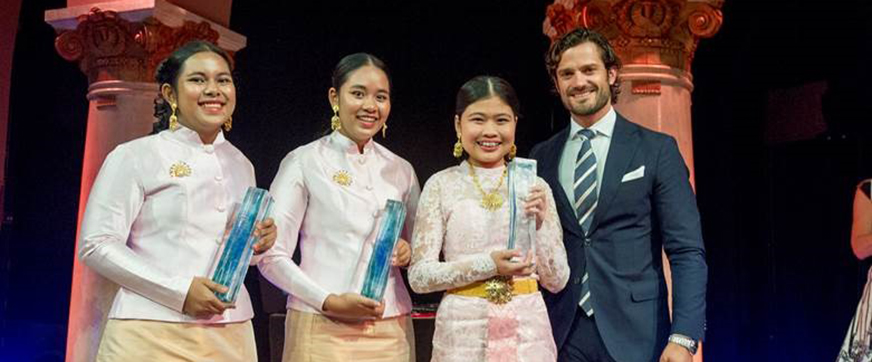
2016 Stockholm Junior Water Prize winners: Sureeporn Triphetprapa, Thidarat Phianchat and Kanjana Komkla. H.R.H. Prince Carl Philip of Sweden presented the prize during World Water Week in Stockholm.

As the three received the prize, Kanjana Komkla said “I’m really happy but I think every team is the best! And thank you everyone.” By examining the efficacy of natural water collection by plants – especially in terms of the shape of plants that collect and capture water – Sureeporn Triphetprapa, Thidarat Phianchat and Kanjana Komkla built a device that mimics the water retention of the Bromeliad plant. The device has also been installed on rubber trees on rubber plantations. For this, they have been awarded the 2016 Stockholm Junior Water Prize, showcasing that nature is the best teacher.

True passion for water

The Jury was impressed by the winners, in particular their exceptional creativity, unrelenting diligence, enthusiasm and true passion for water. “The theme of the 2016 World Water Week is Water for Sustainable Growth. The winning project addresses future water security and rural livelihoods using an elegant leap-frog technology which looks simple, but its beauty masks its complexity! The project embodies the theme well through its journey from the idea to application,” the Jury said in its citation. “It has already proven to be scalable and is now being tested in the field, by hundreds of farmers, who are now benefiting from the inspiration from beautiful plants which have an exceptional capacity to collect and store water.”

"Relieve poverty in our community"

Asked how she would want to take the winning project further, Sureeporn Triphetprapa said: “I will use our idea to relieve poverty in our community.” “This shows that to make real progress towards achieving the Sustainable Development Goals, we need to start at the local level. This is a very good example of that; a simple, smart and scalable solution, making a big difference”, said Torgny Holmgren, Executive Director of SIWI.

Teams from 29 countries

The Stockholm Junior Water Prize competition brings together the world’s brightest young scientists to encourage their continued interest in water and the environment. This year, thousands of participants in countries all over the globe joined national competitions for the chance to represent their nation at the international final held during the World Water Week in Stockholm. Teams from 29 countries competed in the 2016 finals.

"Scientifically sophisticated"

A Diploma of Excellence was awarded to the students Gabriel David Alejandro Trujillo, Eunice Yaneli Masegosa Gaona and Carlos Castellanos Dominguez from Mexico. Their project – a pilot plant – combines an artificial wetland, electrofoculation process and a purification system to promote the use of reclaim water for small agricultural activities and school uses, such as bathroom discharges and cleansing. “This team went right ahead to build and operate the kind of system that is often researched but rarely implemented well – if at all. Their accessible, practical solution is simple. The selection of local plants, previously undervalued, has made this innovation cost-effective to implement, and at the same time scientifically sophisticated,” the Jury said.
Bildquelle, falls nicht im Bild oben angegeben:

Jetzt Newsletter abonnieren

Stoff für Ihr Wissen, jede Woche in Ihrem Postfach.

Hier anmelden

Extremhitze bringt Flüsse an ihre Belastungsgrenze

Die Hitzewelle im Juni 2026 hat in weiten Teilen Europas neue Temperaturrekorde aufgestellt und weitreichende Folgen für Mensch und Umwelt verursacht. Ein Forschungsteam des Karlsruher Instituts für Technologie (KIT) zeigt, wie sich die langanhaltende Hitze auf Gewässer, Energieversorgung, Infrastruktur und Gesundheit ausgewirkt hat. Besonders kritisch seien die Wechselwirkungen zwischen Niedrigwasser, steigenden Wassertemperaturen und Belastungen der Energieversorgung. Die Forschenden warnen, dass anhaltende Hitzewellen künftig zu einem wachsenden Systemrisiko für Europa werden könnten.

mehr lesen
Hitzerekord in Deutschlands Seen

Mit bis zu 32,7 Grad Celsius wurden im Juni 2026 so hohe Wassertemperaturen im Müggelsee gemessen wie nie zuvor. Die Folgen reichen weit über unangenehm warmes Badewasser hinaus: Sauerstoffmangel, gestresste Wasserpflanzen, sterbende Muscheln und schwindende Lebensräume für Fische zeigen, wie der Klimawandel Deutschlands Seen verändert. Forschende des IGB erklären, warum der Temperaturrekord Teil eines langfristigen Trends ist und welche ökologischen Konsequenzen drohen.

mehr lesen
Arbeitsgemeinschaft Wasserversorgung Rhein-Main wählt neuen Vorstand

Die Arbeitsgemeinschaft Wasserversorgung Rhein-Main (WRM) hat ihren Vorstand für die neue Amtsperiode gewählt. Vorsitzende Elisabeth Jreisat wurde im Amt bestätigt, zudem rücken neue und bewährte Mitglieder in das Führungsgremium. Im Fokus stehen die Weiterentwicklung des regionalen Leitungsverbunds und die langfristige Sicherung der Trinkwasserversorgung.

mehr lesen
Aus der Katastrophe gelernt: Wie die Flut 2021 das THW verändert hat

Die Flutkatastrophe im Juli 2021 markierte den größten Einsatz in der Geschichte des Technischen Hilfswerks. Fünf Jahre später zeigt sich: Die Erfahrungen aus dem monatelangen Einsatz an Ahr und Erft haben das THW nachhaltig verändert – von der Ausbildung über die Ausstattung bis hin zu neuen Einsatzmitteln.

mehr lesen
Mit moderner Technik für sauberes Trinkwasser

Die Wasserwerke Westfalen GmbH hat die Modernisierung ihrer Trinkwasseraufbereitung abgeschlossen. Mit der Inbetriebnahme der Weitergehenden Aufbereitungsanlage im Wasserwerk Halingen verfügen nun alle fünf Wasserwerke über zusätzliche technische Verfahrensstufen, die das bewährte naturnahe Aufbereitungskonzept ergänzen und die Versorgung langfristig absichern. Insgesamt wurden rund 160 Millionen Euro in das Projekt investiert.

mehr lesen

Passende Firmen zum Thema:

Sie möchten die gwf Wasser + Abwasser testen

Bestellen Sie Ihr kostenloses Probeheft

Überzeugen Sie sich selbst: Gerne senden wir Ihnen die gwf Wasser + Abwasser kostenlos und unverbindlich zur Probe!

Finance Illustration 03