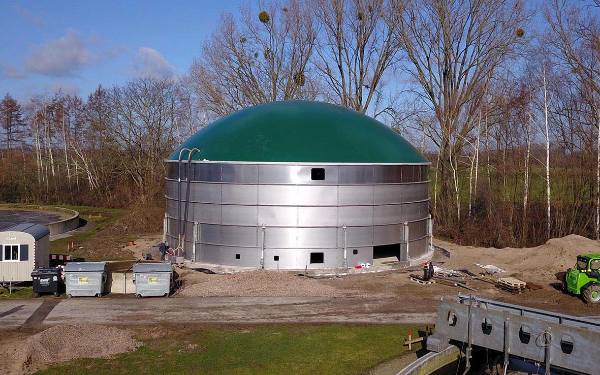
Following a public tender procedure, WELTEC BIOPOWER was awarded the contract for an anaerobic stage for the municipal sewage treatment plant in Bückeburg, North Germany. Apart from the earthworks and the electrical installations, the German biogas plant manufacturer will supervise the construction of the new sludge thickener, the engine room for the cogeneration power plant and the digester with its gas storage roof.
Henceforth, the sludge will undergo anaerobic digestion in the stainless-steel digester. The budget for the various modernisation measures on the premises total €4.14 million. The anaerobic stage will be ready to go live in October 2021.
Until now, the sewage treatment plant with a capacity of 33,000 PE (population equivalents) has applied aerobic wastewater treatment. The conversion to anaerobic sludge stabilisation will put the entire plant on track towards economic and ecological success. The new wastewater treatment solution is set to optimise operating processes and deliver significantly higher energy efficiency. Moreover, the new process is expected to reduce the sewage treatment plant’s greenhouse gas emissions by 664 t/year. Within the framework of the European Regional Development Fund (ERDF), the investment and development bank of Lower Saxony (NBank) rewards the carbon savings with a subsidy of €1 million.
Besides the ecological improvement, WELTEC’s anaerobic wastewater treatment will result in a significant cost reduction. For instance, the amount of sludge that accumulates every year will go down from 2,800 t to 1,800 t. Additionally, some 5 percent of the power consumption will be saved. The greatest savings potential, however, lies in the sludge gas: “With the 465,000 kWh of power that we will gain from the sewage gas every year, we will be able to cover 40 percent of our own power demand”, says Rainer Klenke. The technical manager of the wastewater operations of the municipality of Bückeburg calculates that the yearly power bill will drop by two thirds from €195,000 to €65,000.
The expertise for this optimisation concept originates from biogas technology. WELTEC BIOPOWER will implement the digester as a stainless-steel tank in the tried-and-tested segmental design with a double-paddle mixer. The digester will have a height of 6.3 m, a diameter of about 19 m, and a capacity of 1,823 m³. The sewage gas will be stored in the flexible double-membrane roof with a volume of approx. 600 m³. This design stands out with much lower investment costs than a conventional digester and is therefore an optimum solution for smaller wastewater treatment plants. The new static sludge thickener, which is equipped with a submersible mixer and boasts a capacity of 342 m³, is also made of stainless steel. A 226-kW CHP unit will ensure efficient utilisation of the gas. Both the generated power and the heat will be used on the plant premises. Additionally, a gas boiler with an output of 170 kW will be installed in the engine room in order to ensure the heat supply of the digester even during maintenance work on the cogeneration power plant.
The municipal sewage treatment plant will thus experience an efficiency boost thanks to technological and process-related improvements. Apart from the anaerobic stage, a primary clarifier will be newly integrated in the process. In this way, primary sludge will be extracted from the wastewater, reducing the chemical oxygen demand (COD) by a third. The lower this value, the easier the water can be treated. This reduces the aeration period in the aeration tank and thus the energy costs. Thomas Sextro, Sales Manager at WELTEC BIOPOWER, explains: “Aerobically stabilised sludge contains a higher organics load and is more difficult to dewater. With the anaerobic process, the dewatered sludge has about 35 percent less volume, which saves sludge transportation and disposal costs.”
Such smart combinations of wastewater treatment, energy generation, and climate protection make existing sewage treatment plants future-proof. The cost-efficient technologies and proven concepts from the field of biogas are suitable to counteract fluctuating energy prices and increasing sludge utilisation costs. In Bückeburg, for example, this enables the municipality to keep its wastewater and surface water drainage costs steady without burdening the citizens with extra fees.