
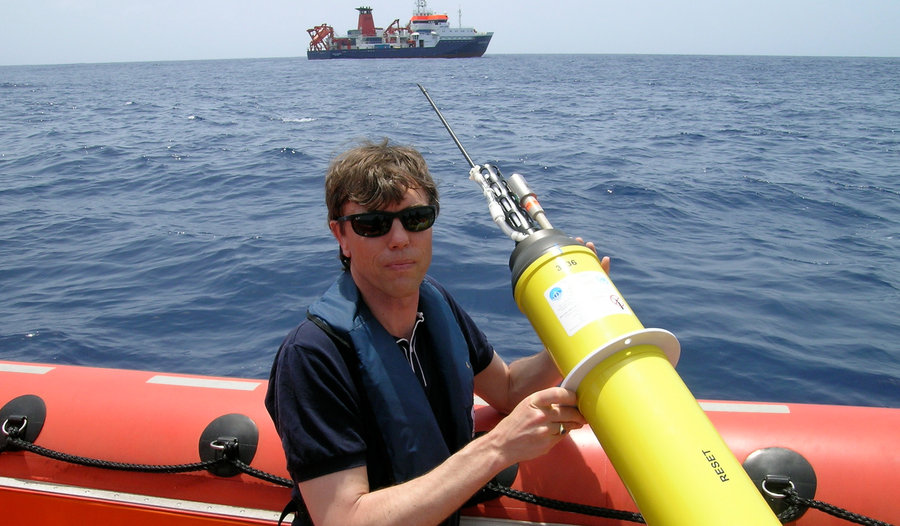
Oceanography is still a very young field in natural sciences. The American oceanographer Henry Melson Stommel, born in 1920, was a pioneer in this field. He made important contributions in the field of physical oceanography. Stommel developed basic theories about the global circulation patterns of the oceans and the behaviour of the Gulf Stream, which still are the basis of todays’ physical oceanography. 1995, three years after his death, the American Meteorological Society named the award after him. The Henry-Stommel Research Medal is awarded to scientists who made outstanding contributions to the understanding of the dynamics and physics of the ocean.
So far, the only other German scientist alongside Professor Visbeck who received this prestigious award was his teacher and mentor Friedrich Schott from Kiel in 2004.
“I feel extremely honored and I am delighted to be able to personally accept this prestigious award today”, said Prof. Martin Visbeck at the award ceremony that took place at the 99th annual meeting of the American Meteorological Society in Phoenix, AZ, USA. “Special thanks to my team at GEOMAR in Kiel and many colleagues worldwide, with whom I have been able to conduct such successful research in recent years”, Visbeck continued.
Professor Martin Visbeck studied physical oceanography at Kiel University. After his PhD, he first worked as a postdoc at the renowned Massachusetts Institute of Technology (MIT) in Boston before moving to Columbia University in New York in 1997. In 2004 he returned to Kiel on a professorship at Kiel University and as the head of the research unit "Physical Oceanography" at the former Leibniz Institute of Marine Sciences.
Amongst other functions, he serves as spokesman for the Kiel Cluster of Excellence "Future Ocean", President of The Oceanography Society, as a member of the Joint Scientific Committee of the World Climate Research Programme, and many national and international committees. Martin Visbeck is the author of about 100 scientific papers in peer-reviewed journals and has received numerous awards for his research achievements.
Henry Stommel Research Medal for German oceanographer Martin Visbeck
Kategorie: People
Autor: Jonas Völker
Das könnte Sie auch interessieren:
Apr
2023
Hydrologist Andrea Rinaldo Wins Stockholm Water Prize 2023
The world-renowned hydrologist Andrea Rinaldo is awarded the Stockholm Water Prize 2023 for his ground-breaking research on river networks, demonstrating their significance in the spread of solutes, aquatic species, and ...
Feb
2023
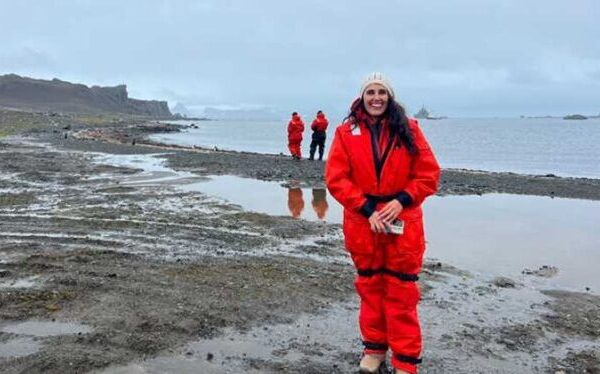
Ice Water Swimming to protect the Antarctica
The Chilean ice-water swimmer Bárbara Hernández is about to undertake the longest swim ever done by a person to raise awareness for the need to protect Antarctica and the Southern ...
Dez
2022
The Earthshot Prize Awards in Boston
The 2022 Earthshot Prize Awards took place on Friday, December 2nd at the MGM Music Hall in Boston. Prince William and The Earthshot Prize revealed the 2022 Earthshot Prize winners – an accomplished group of ...
Passende Firmen zum Thema:
Publikationen
Sie möchten die gwf Wasser + Abwasser testen
Bestellen Sie Ihr kostenloses Probeheft
Überzeugen Sie sich selbst: Gerne senden wir Ihnen die gwf Wasser + Abwasser kostenlos und unverbindlich zur Probe!