Filter by Themen
Filter by Kategorien
Filter by Veranstaltungsschlagworte
FS Logoi

Haliotis 2: Wastewater recovery and treatment complex

On April 20th the future, next-generation wastewater recovery and treatment complex for the Métropole Nice Côte d’Azur "Haliotis 2" was presented.

von | 16.05.23

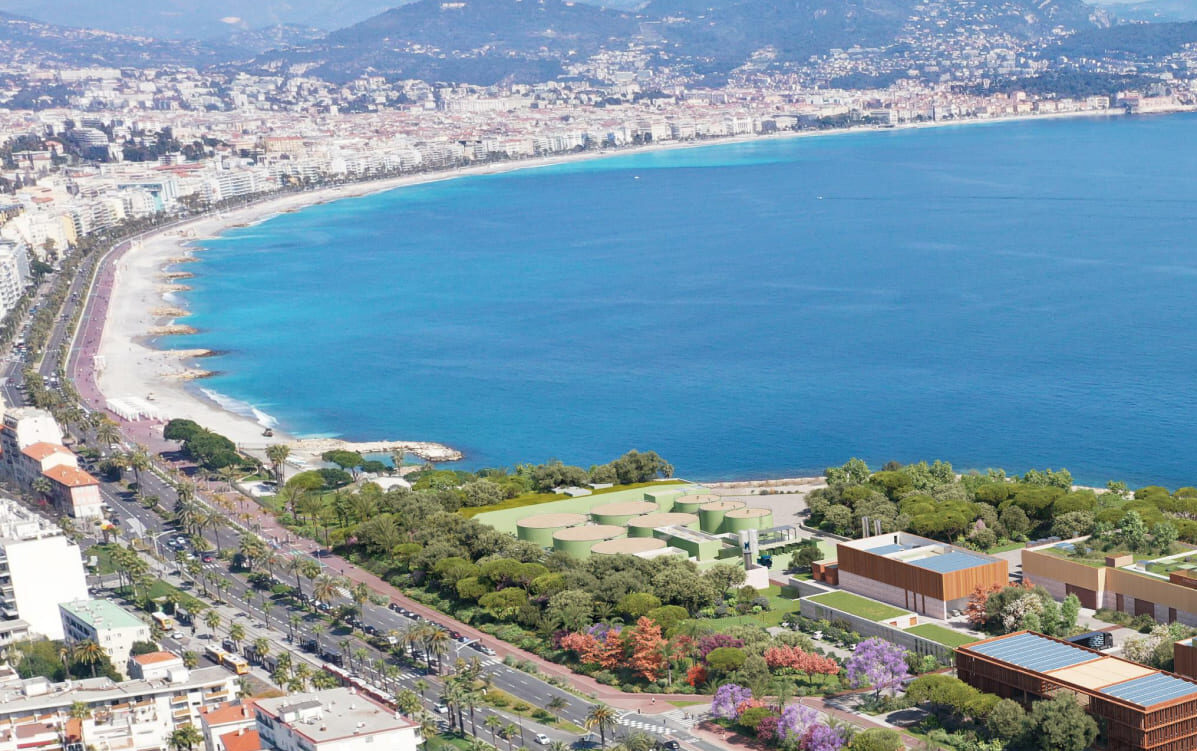
The project "Haliotis 2" aims to create a remarkable urban-rural hybrid landscape at the entrance of the city with 4.5 hectares of biodiversity composed of 600 trees, colorful hedges, and shrubs.
Foto: suez group
wastewater recovery

May 16, 2023 Ι On April 20th the future, next-generation wastewater recovery and treatment complex for the Métropole Nice Côte d’Azur „Haliotis 2“ was presented. Christian Estrosi, Mayor of Nice, President of the Métropole Nice Côte d’Azur and Deputy President of the Région Provence-Alpes-Côte d’Azur and Sabrina Soussan, Chairman and CEO of SUEZ, presented the (to this point) largest project in France and one of the largest in Europe.

Haliotis 2 will be a true European hub for advanced “all-in-one” technologies working toward the ecological transition to treat and reuse wastewater, eliminate all types of pollutants including microplastics, treat sewage sludge and sand, and improve air quality, all while generating new renewable energy sources (biomethane, solar, heat and cold for buildings).

“Water resources are a major issue of our time, especially for our region. It is our duty to do everything possible to safeguard it. This future complex, a first in France, will allow us to meet the challenges of the coming decades and keep our metropole ahead of the game. It will play an important role in achieving the objective of our Climate Plan, which aims to reduce our greenhouse gas emissions by 55% by 2030 and achieve carbon neutrality by 2050,” said Christian Estrosi.

Wastewater recovery in Nice

The water treatment performance of Haliotis 2 will exceed sanitary standards with nearly 90% of microplastics being eliminated by the plant. It will have an industrial unit for the reuse of treated wastewater capable of recycling 5 million cubic meters of water per year, which is enough to water the green spaces and clean the roads of the city of Nice.

Haliotis 2 will also have exemplary energy credentials as it will help to decarbonize the region. It will produce four times the energy that it consumes today. It will enable optimal energy recovery of sludge from wastewater treatment and produce sufficient biomethane for 11,000 homes, or the equivalent of 290 buses. The additional energy potential of dried sludge will be fully exploited at the Ariane energy recovery unit in Nice via its heating network. Lastly, the heat potential of treated wastewater will be exploited via the heating network irrigating the airport and the Grand Arénas district.

Bildquelle, falls nicht im Bild oben angegeben:

Jetzt Newsletter abonnieren

Stoff für Ihr Wissen, jede Woche in Ihrem Postfach.

Hier anmelden

GEOMAR startet Ostsee-Expeditionen zur Erforschung von Seegras und Phytoplankton

Mit drei Forschungsexpeditionen in der Ostsee untersucht das GEOMAR Helmholtz-Zentrum für Ozeanforschung Kiel den Zustand von Seegraswiesen und Phytoplankton. Im Mittelpunkt stehen deren Bedeutung für den Kohlenstoffkreislauf sowie ihre Rolle als Indikatoren für den ökologischen Zustand des Meeres. Die gewonnenen Daten sollen dazu beitragen, die Auswirkungen des Klimawandels besser zu verstehen und wirksame Schutz- und Wiederherstellungsmaßnahmen für die Ostsee zu entwickeln.

mehr lesen
Wie Klimamuster die Widerstandskraft von Korallenriffen beeinflussen

Korallenriffe werden bei marinen Hitzewellen nicht immer gleich gut durch natürliches kühles Tiefenwasser geschützt. Eine neue Studie zeigt, dass großräumige Klimamuster wie El Niño und der Indische-Ozean-Dipol maßgeblich bestimmen, wie wirksam diese natürliche Kühlung ausfällt. Die Erkenntnisse könnten helfen, besonders widerstandsfähige Riffe künftig gezielter zu schützen.

mehr lesen
Wenn die Heimat im Giftsee versinkt

Wo einst Häuser, Wiesen und Höfe standen, breitet sich heute ein orangefarbener See aus. Seine auffällige Farbe ist das Ergebnis jahrzehntelangen Kupferbergbaus und er steigt Jahr für Jahr weiter an. Mit seinem Dokumentarfilm „where we used to sleep“ macht Regisseur Matthäus Wörle diese Entwicklung am Schicksal einer der letzten Bewohnerinnen des Dorfes sichtbar. Im Gespräch erzählt er von den Dreharbeiten, der Umweltproblematik vor Ort und davon, warum persönliche Geschichten oft mehr bewegen als bloße Zahlen.

mehr lesen

Passende Firmen zum Thema:

Sie möchten die gwf Wasser + Abwasser testen

Bestellen Sie Ihr kostenloses Probeheft

Überzeugen Sie sich selbst: Gerne senden wir Ihnen die gwf Wasser + Abwasser kostenlos und unverbindlich zur Probe!

Finance Illustration 03