This will be the 5th EIP Water Conference, after Brussels (2013), Barcelona (2014), Leeuwarden (2016) and Porto (2017), and shall build upon the European Innovation Partnership (EIP Water)’s efforts so far to foster innovation in the water sector and overcome the main existing barriers. At the same time, it is a stepping stone into the future, as the current EIP Water is planned to end in 2020, and it will likely be followed by new actions to address water-related challenges, secure enhanced compliance with the EU water acquis and foster the research-policy interface, whilst strengthening partnerships for joint efforts.
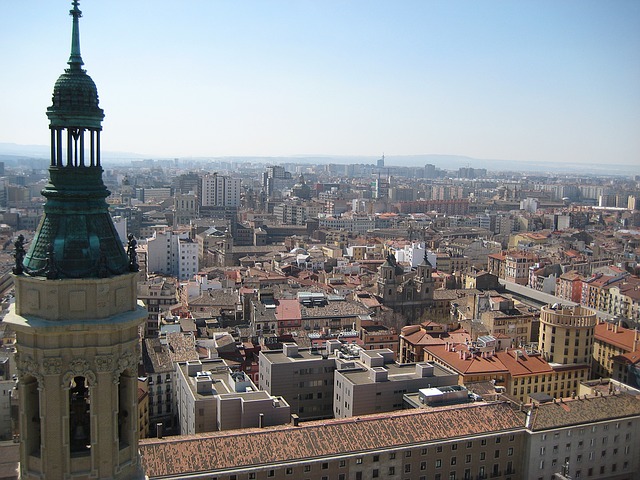
The city of Zaragoza was selected as a host city after a pan-European competition won by the Region of Aragon (Spain).
Aragon’s proposal builds on a strong legacy of hosting the water-focused World Expo in 2008, and a strong institutional, entrepreneur and civil society engagement in water. Zaragoza and the conference venue are located at the Ebro river banks, and Aragon faces many of the today’s and tomorrow’s challenges on water management, including pollution, floods, scarcity and droughts. At the same time, Aragon is a dynamic region, with strong innovation activities related to the circular economy and sustainability. Zaragoza is a recognized congress city with important events such as Smagua International Water and Irrigation exhibition.
Detailed information about the program, registration and speakers can be found here.
Text source: EIP Water (©European Union, 1995-2012)
EUWIC 2019 to be held in Zaragoza
Kategorie: Sonstiges
Themen: Events | Water Solutions
Autor: Jonas Völker
Das könnte Sie auch interessieren:
Mrz
2024
Trügerische Idylle: Stettiner Haff ist Bedrohter See des Jahres 2024
Das Stettiner Haff erstreckt sich über beide Seiten der deutsch-polnischen Grenze. Mit seiner Größe von 70.000 ha und als Teil des Oderdeltas spielt es eine Schlüsselrolle bei der Erhaltung der Artenvielfalt in der ...
Mrz
2024
Rasante Raubfische wechseln Farben auf der Jagd
Eine Studie des Exzellenzclusters "Science of Intelligence" (SCIoI) mit der Humboldt-Universität zu Berlin und dem IGB erforscht, wie die gestreiften Marline die schnelle Abfolge ihrer Angriffe koordinieren können, ...
Feb
2024
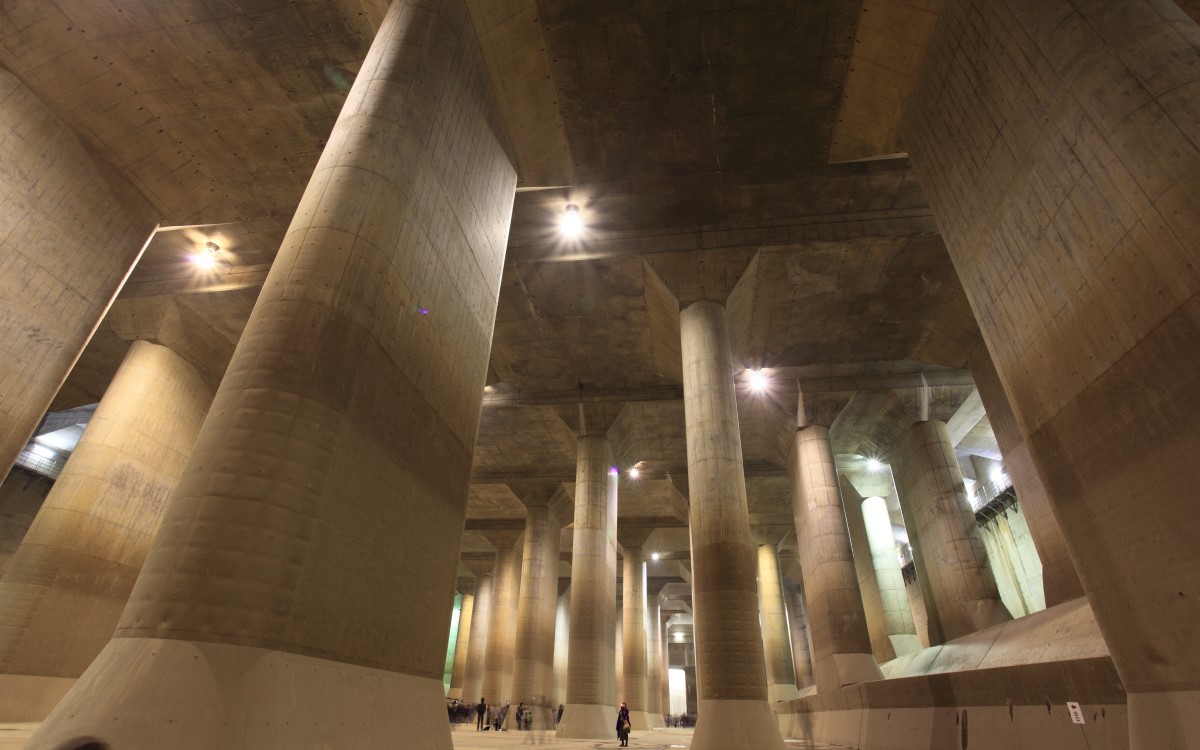
Unterirdischer Wassertempel schützt vor Hochwasser
20. Februar 2024 ǀ In Japan findet sich das weltgrößte unterirdische Entwässerungs- und Kanalisationssystem, genannt Shutoken Gaikaku Hōsuiro (首都圏外郭放水路, dt. etwa äußerer Entwässerungskanal für ...
Passende Firmen zum Thema:
Publikationen
Water Sensitive Urban Design as a Role Model for Water Management in Germany?
Autor: Jacqueline Hoyer / Juliane Ziegler
Themenbereich: gwf - Wasser|Abwasser
Erscheinungsjahr: 2013
“Water Sensitive Urban Design” (WSUD), originally developed in Australia, is a planning and design approach combining the functionality of water management with principles of urban design. WSUD is mainly used in the development of integrated ...
Tertiary Filtration with Ultrafiltration Membranes in Municipal Wastewater Treatment Plants
Autor: Martin Wett and Eberhard Back
Themenbereich: gwf - Wasser|Abwasser
Erscheinungsjahr: 2011
During the operation of tertiary filtration stages in a dead-end-mode, retentate concentrate and rinsing water from membrane cleaning accrue naturally. Work on process solutions for these process waters with no additional particle loads for the ...
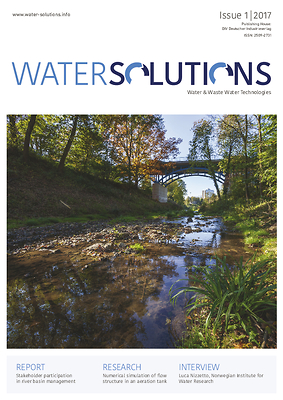
Water Solutions – 01 2017
Themenbereich: Water SolutionsErscheinungsjahr: 2017
The leading professional magazine for water and wastewater ...
Sie möchten die gwf Wasser + Abwasser testen
Bestellen Sie Ihr kostenloses Probeheft
Überzeugen Sie sich selbst: Gerne senden wir Ihnen die gwf Wasser + Abwasser kostenlos und unverbindlich zur Probe!