
The question whether nanoparticles tend to agglomerate in water or not is essential for both the correct analysis of particle size distributions and concentrations of size fractions, as well as for evaluating the possibilities to remove these particles from water, e.g. by filtration.
TiO₂ (titanium dioxide) NP are widely used in sunscreens and wall paints and CeO₂ (cerium dioxide) NP are applied as catalyst in the automotive industry, as polishing agent in the semiconductor industry or in coatings of optical glasses [2]. Polystyrene nanoparticles may emerge from the fragmentation of plastic litter.
To obtain a better understanding how these three types of NP behave in the presence of hardness builders, different pH values and natural organic matter, Serge Stoll and his co-workers suspended these NP in: ultrapure water, three bottled mineral waters, in water from the Lake Geneva and in drinking water produced from Lake Geneva water.
By analyzing the NP’s surface charge (via zeta potential measurement) and sizes (as hydrodynamic diameters via laser doppler anemometry and dynamic light scattering as well as via scanning electron microscopy) the authors showed that both water hardness and negatively charged natural organic matter are playing important roles in connection with the surface charge of the NP. Negatively charged TiO₂ and CeO₂ NP tend to agglomerate at environmental pH if special cations (hardness) are present. The adsorption of natural organic matter to positively charged PS NP is considered as key process in the destabilization of the PS NP.
References:
[1] L. Ramirez, S. Ramseier Gentile, S. Zimmermann, S. Stoll: behaviour of TiO2 and CeO2 Nanoparticles and Polystyrene Nanoparticles in Bottled Mineral, Drinking and Lake Geneva Waters. Impact of Water hardness and Natural Organic Matter on Nanoparticle Surface Properties and Aggregation. Water 2019, 11, 721, doi: 10.3390/w11040721
[2] www.nanopartikel.info
Behavior of nanoparticles in water
Kategorie: Publications
Thema: Water Solutions
Autor: Jonas Völker
Das könnte Sie auch interessieren:
Apr
2024
Even in nature, pride can prevail
Sea anemones that live on the rocky coasts of the Atlantic are exposed to large differences in water temperature. Depending on the individual's personality, they cope with the heat ...

Jan
2024
How to identify liquid water on exoplanets
Scientists have devised a new way to identify habitable planets and potentially inhabited planets, by comparing the amount of carbon dioxide in their atmosphere, to neighbouring planets. The research was published on 28 ...
Jan
2024
More protection for groundwater
Groundwater is a keystone ecosystem. An international study proposes ways to improve its protection to preserve biodiversity and mitigate climate ...
Passende Firmen zum Thema:
Publikationen
Water Sensitive Urban Design as a Role Model for Water Management in Germany?
Autor: Jacqueline Hoyer / Juliane Ziegler
Themenbereich: gwf - Wasser|Abwasser
Erscheinungsjahr: 2013
“Water Sensitive Urban Design” (WSUD), originally developed in Australia, is a planning and design approach combining the functionality of water management with principles of urban design. WSUD is mainly used in the development of integrated ...
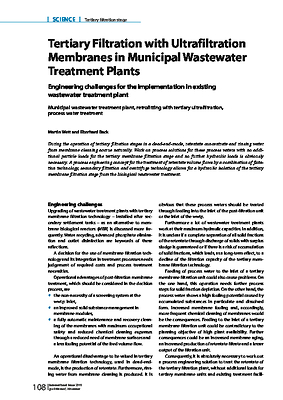
Tertiary Filtration with Ultrafiltration Membranes in Municipal Wastewater Treatment Plants
Autor: Martin Wett and Eberhard Back
Themenbereich: gwf - Wasser|Abwasser
Erscheinungsjahr: 2011
During the operation of tertiary filtration stages in a dead-end-mode, retentate concentrate and rinsing water from membrane cleaning accrue naturally. Work on process solutions for these process waters with no additional particle loads for the ...
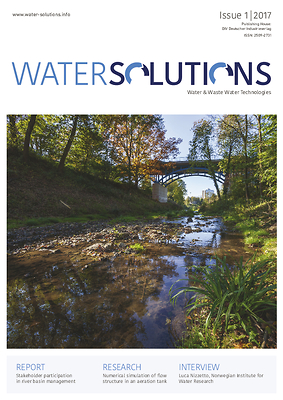
Water Solutions – 01 2017
Themenbereich: Water SolutionsErscheinungsjahr: 2017
The leading professional magazine for water and wastewater ...
Sie möchten die gwf Wasser + Abwasser testen
Bestellen Sie Ihr kostenloses Probeheft
Überzeugen Sie sich selbst: Gerne senden wir Ihnen die gwf Wasser + Abwasser kostenlos und unverbindlich zur Probe!