
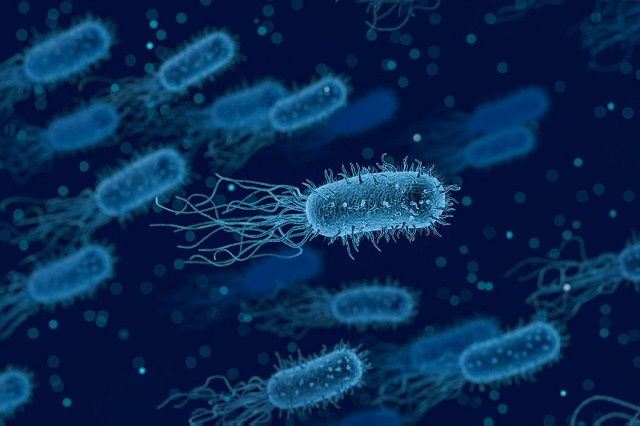
Text source: Monash University The international team, led by Professor Xiwang Zhang in Monash University’s Department of Chemical Engineering, combined graphitic carbon nitride with polyethylenimine (PEI) to destroy harmful pathogens E. coli and Enterococcus faecalis from water within 45 minutes and 60 minutes respectively.
This new photocatalyst method is low cost and metal-free, which prevents secondary pollution of leached metal ions during the filtration process.
If upscaled, this solar-driven method could significantly improve the treatment of large volumes of water. It also has the potential to be integrated into current solar water disinfection technology in countries with limited access to fresh water.
Published in the journal Applied Catalysis B: Environmental*, Professor Zhang says integrating their photocatalyst into solar water disinfection technology could nearly ensure complete and rapid disinfection in a more sustainable way.
To read the full article, please visit Monash University’s website.
*https://www.sciencedirect.com/science/article/abs/pii/S0926337320305105?via%3Dihub
Engineers devise new method to remove E. coli from water
Kategorie: Publications
Thema: Water Solutions
Autor: Jonas Völker
Das könnte Sie auch interessieren:
Apr
2024
Even in nature, pride can prevail
Sea anemones that live on the rocky coasts of the Atlantic are exposed to large differences in water temperature. Depending on the individual's personality, they cope with the heat ...
Jan
2024
How to identify liquid water on exoplanets
Scientists have devised a new way to identify habitable planets and potentially inhabited planets, by comparing the amount of carbon dioxide in their atmosphere, to neighbouring planets. The research was published on 28 ...
Jan
2024
More protection for groundwater
Groundwater is a keystone ecosystem. An international study proposes ways to improve its protection to preserve biodiversity and mitigate climate ...
Passende Firmen zum Thema:
Publikationen
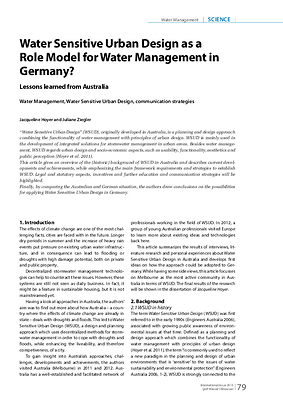
Water Sensitive Urban Design as a Role Model for Water Management in Germany?
Autor: Jacqueline Hoyer / Juliane Ziegler
Themenbereich: gwf - Wasser|Abwasser
Erscheinungsjahr: 2013
“Water Sensitive Urban Design” (WSUD), originally developed in Australia, is a planning and design approach combining the functionality of water management with principles of urban design. WSUD is mainly used in the development of integrated ...
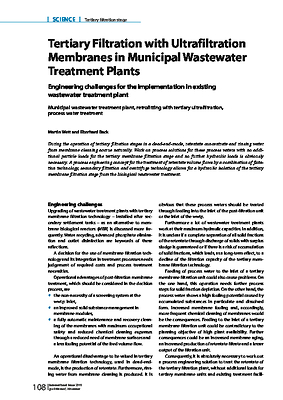
Tertiary Filtration with Ultrafiltration Membranes in Municipal Wastewater Treatment Plants
Autor: Martin Wett and Eberhard Back
Themenbereich: gwf - Wasser|Abwasser
Erscheinungsjahr: 2011
During the operation of tertiary filtration stages in a dead-end-mode, retentate concentrate and rinsing water from membrane cleaning accrue naturally. Work on process solutions for these process waters with no additional particle loads for the ...
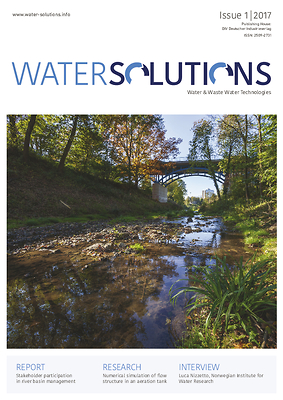
Water Solutions – 01 2017
Themenbereich: Water SolutionsErscheinungsjahr: 2017
The leading professional magazine for water and wastewater ...
Sie möchten die gwf Wasser + Abwasser testen
Bestellen Sie Ihr kostenloses Probeheft
Überzeugen Sie sich selbst: Gerne senden wir Ihnen die gwf Wasser + Abwasser kostenlos und unverbindlich zur Probe!