

The proposed desalination facility will provide 50 MGD (189,3 m3/d) to about 400,000 Orange County residents. The plant will be the County’s largest single source of local water supply.
In 2015, Poseidon Water, a private company that partners with public agencies to deliver water infrastructure projects, and the Orange County Water District, entered into a Water Purchase Agreement Term Sheet for the purchase of the plants’ full 50 MGD capacity. The benefits of the credit assistance provided by WIFIA to the project was told to result in a direct financial pass through to the Orange County water ratepayers, which, Poseidon estimated, will reduce water costs by $290 million over the life of the project as compared to alternative financing options.
According to Poseidon Water, the Huntington Beach Facility will use state- of-the-art filtration technology, and it will be safe for the marine environment. The latter is due to the characteristics of the coastal area with soft, sandy bottom, no Areas of Special Biological Significance (like coral reefs, for example), and the relatively low salt content of the sea water. Thus, the company states that adding the brine from the desalination plant would lead to salt concentrations around the discharge point that are on the same level as the concentration found in Baja California. Full carbon neutrality is planned to be achieved by offsetting all of the direct and indirect emissions from the construction and operation of the facility.
$585 Million for carbon-neutral seawater desalination facility in Southern California
Kategorie: Products & Solutions
Thema: Water Solutions
Autor: Jonas Völker
Das könnte Sie auch interessieren:
Jun
2023
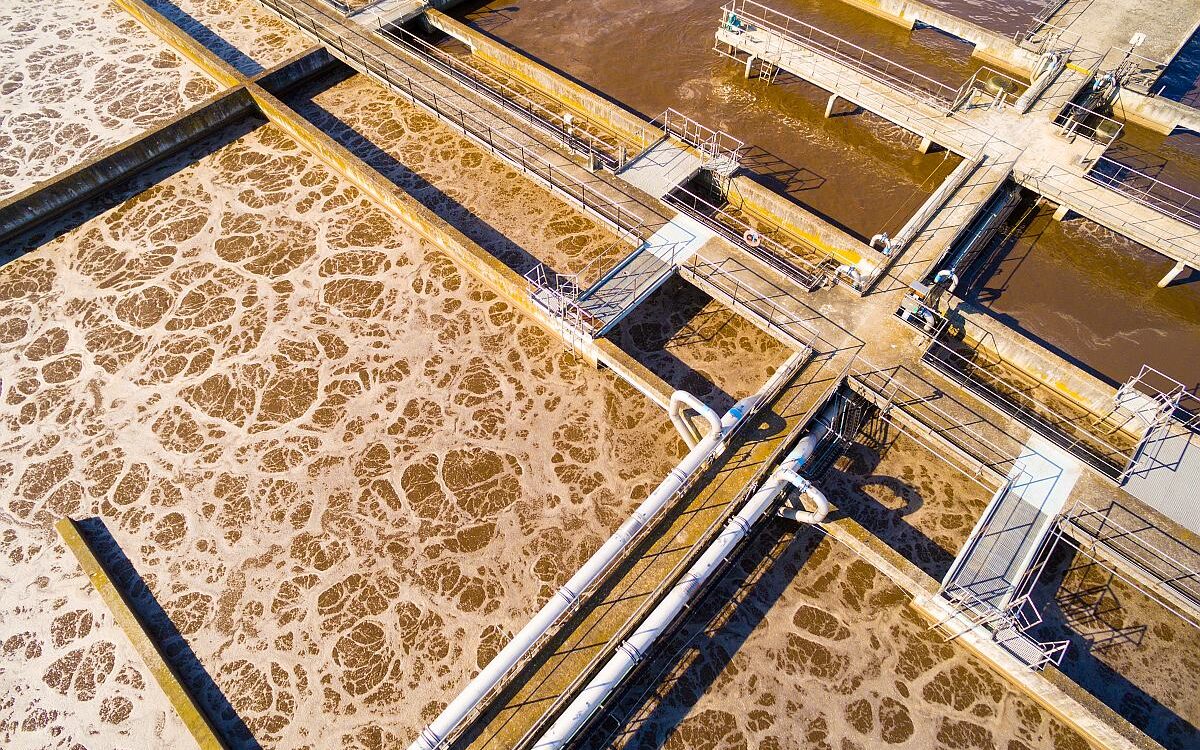
Full ‘at scale trial’ of technology to cut NO₂ emissions of a WWTP
Suez announces its partnership with Severn Trent Water in the multimillion Net Zero Hub set to start in September in the latter's Strongford Sewage Treatment Works in Staffordshire, ...
Apr
2023
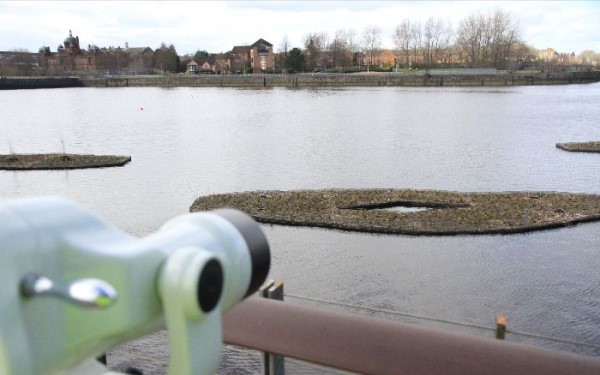
Increasing Biodiversity on the River Clyde at Glasgow Science Centre
Biomatrix Water has installed Biomatrix Floating Ecosystems at the Science Centre in Glasgow. Glasgow Science Centre is a cutting edge visitor attraction bringing the wonder of science to hundreds of thousands of ...
Mrz
2023
Novel Membranes for Better Wastewater Treatment
Together with population growth and industrialisation, water scarcity tops the list of global ...
Passende Firmen zum Thema:
Publikationen
Water Sensitive Urban Design as a Role Model for Water Management in Germany?
Autor: Jacqueline Hoyer / Juliane Ziegler
Themenbereich: gwf - Wasser|Abwasser
Erscheinungsjahr: 2013
“Water Sensitive Urban Design” (WSUD), originally developed in Australia, is a planning and design approach combining the functionality of water management with principles of urban design. WSUD is mainly used in the development of integrated ...
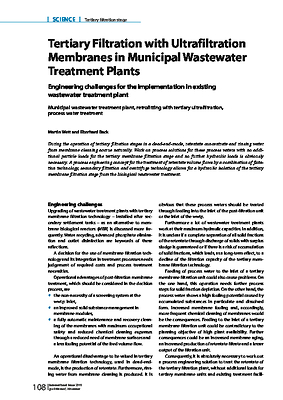
Tertiary Filtration with Ultrafiltration Membranes in Municipal Wastewater Treatment Plants
Autor: Martin Wett and Eberhard Back
Themenbereich: gwf - Wasser|Abwasser
Erscheinungsjahr: 2011
During the operation of tertiary filtration stages in a dead-end-mode, retentate concentrate and rinsing water from membrane cleaning accrue naturally. Work on process solutions for these process waters with no additional particle loads for the ...
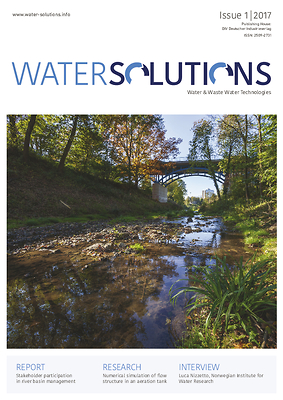
Water Solutions – 01 2017
Themenbereich: Water SolutionsErscheinungsjahr: 2017
The leading professional magazine for water and wastewater ...
Sie möchten die gwf Wasser + Abwasser testen
Bestellen Sie Ihr kostenloses Probeheft
Überzeugen Sie sich selbst: Gerne senden wir Ihnen die gwf Wasser + Abwasser kostenlos und unverbindlich zur Probe!